oppo f5 review
 | |
| oppo f5 |
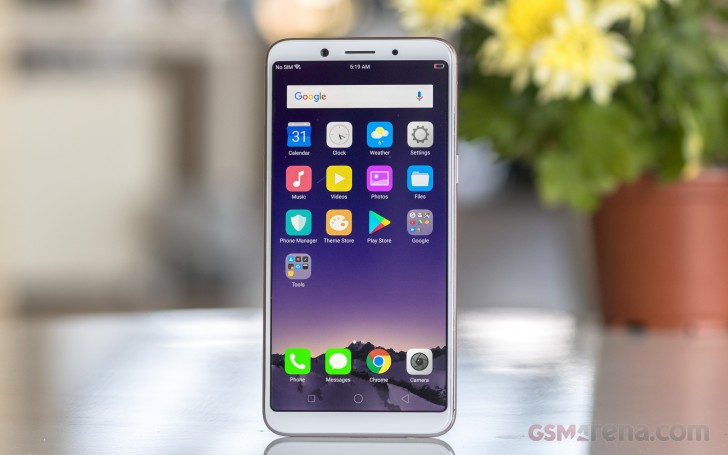
It literally covers all the current trends: Trim bezels, ultra-wide aspect, AI-powered selfies, Apple-style face unlock and heavily iOS-inspired UI - all accounted for. All the while, concepts like a dual selfie setup have already been pushed to the side, just to stay in tune with the tone of the day.
We get it, being trendy and staying relevant is important, especially in an increasingly over-saturated market. The BBK Electronic Corporation really seems to take that idea to heart, as the Vivo V7+ and the OnePlus 5T can both testify, with their equally speedy adoptions on the trendy ultra-wide aspect ratio.
Oppo F5 key features:
- Body: Polycarbonate unibody
- Screen: 6.0" LTPS IPS LCD, 1080x2160px resolution (18:9)
- Chipset: Mediatek MT6763T Helio P23 chipset: octa-core Cortex-A53 CPU (8x2.5GHz); Mali-G71 MP2 GPU
- Memory: 4GB/6GB of RAM, 32GB/64GB of inbuilt storage, microSD slot
- OS: Android 7.1.1; Color OS 3.2
- Rear camera: 16MP f/1.8; PDAF; LED flash
- Front camera: 20MP, f/2.0, 1/2.8" sensor size, autofocus
- Battery: 3,200mAh
- Connectivity: LTE Cat.7 (300 Mbps/150 Mbps), Wi-Fi a/b/g/n, Bluetooth 4.2, Micro USB
- Misc: Fingerprint sensor on the back, Face unlock
Main shortcomings
- No fast charging solution
- No NFC
- Older Micro USB port
But, that definitely doesn't mean we can't frown at the phone's polycarbonate unibody - a clear downgrade over its F3 predecessor. Or be a little saddened by the constant sharp shifts in design direction within the "selfie expert" family, as well as the overpowering ambition to copy Apple's every step as close as copyright laws allow and perhaps even beyond.


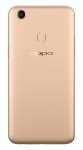

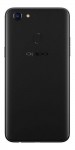
Oppo F5 in official photos
Battery Life
The Oppo F5 packs a decently sized 3,200 mAh battery, just like its F3 predecessor. It is not a battery beast, by any means, but to reiterate a previous point, the new plastic body has allowed Oppo to keep weight down at 152 grams, even with the same battery capacity and a larger display.Also, we went into the battery test segment with high hopes for any potential endurance improvements by the new MediaTek Helio P23 chip. Still, we can't realistically expect an amazing difference over the Helio P20, since both are based on the same 16nm TSMC fabrication process.
As expected, the numbers show the new Helio P23 is just as frugal as its older sibling when it comes to battery life. It scored a great endurance rating of 91 hours, with good scores across the board. Well, video playback could use use some extra optimization. But other than that, a very good score.
Also, one that falls in line well with expectation. For instance, the Sony Xperia XA1 Plus leveraged its Helio P20 chipset and 3,420 mAh nattery well enough to score a 102 hour endurance rating. The slight bump in battery capacity mostly went towards improving standby performance. All the on-screen tests, as well as the call one come really close to what we measured on the Oppo, so a nice consistent and impressive showing from MediaTek's 16nm mid-range chips overall.
Charging on the F5 is limited to a simple 5V@2A current. Just like with the F3, VOOC was apparently way out of budget. It is definitely missed, though, since Oppo's fast charging solution remains one of the best on the market.
With its bundled 5V@2A charger, the Oppo F5 goes from 0% to 49% in half an hour. Not bad.
Connectivity
While the new Helio P23 comes really close to the older P20 in CPU terms, it does offer a few notable improvements in the connectivity department. With it, MediaTek wants to somewhat bridge the gap between its higher-end solutions, lithe the Helio X30 and the mid-range, by providing some meaningful network improvements.The Helio P23 supports Dual 4G LTE and DSDS (Dual SIM, Dual standby) on both its slots, but also Dual VoLTE/ViLTE. That means both SIM cards can take advantage of high bandwidth data transfer and crisp audio calls. Given the proper PR and exposure, this could serve as a major selling point for the Oppo F5, especially in markets with a 4G-only infrastructure.
As far as specific numbers go, the Helio P23 is rated at Cat.6 LTE, with a theoretical maximum of 300 Mbps down. You also get 20Mz + 20Mz carrier aggregation. According to our findings, there are actually two variants of the Oppo F5. One has a total of 12 LTE bands and four HSPDA ones, while the other has 9 and 3, respectively.
On the local side of things, the Oppo F5 has Wi-Fi a/b/g/n, Bluetooth 4.2 and LE profiles. There are also a GPS and an FM radio receiver. No NFC, though. The microUSB port does support OTG (you do have to toggle it in the settings), but is only capable of USB 2.0 transfer speeds.
Performance
The Oppo F5 is the first phone to come through the office, equipped with MediaTek's new MT6763T Helio P23 chipset. Back in the communication section of the review, we established the main goal with the P23 was to provide advanced network features for a mass market, rather than any meaningful performance bump over the older Helio P20. Since both chips are based on the same 16nm manufacturing process and
use a total of eight Cortex-A53 cores (4 @ 2.3GHz and 4 @ 1.6GHz), this
should definitely be true for CPU performance. We are sure that most if
not all synthetic tests would gladly back us up on this claim, but the
Oppo F5 refused to run GeekBench at all.
However, in the meantime, we do have Basemark OS for a pure CPU performance assessment. We opted for the older BaseMark OS II version, since the newer one seems to have some issues with the new Helio P23 chipset for some reason.
Basemark OS II
Higher is better
- Oppo F3 Plus 2349
- Xiaomi Mi A1 1392
- vivo V7+ 1367
- Sony Xperia XA1 1367
- Xiaomi Redmi Note 4 (S625) 1290
- Oppo F5 1286
- Xiaomi Mi Max 2 1235
- Samsung Galaxy J7 Pro 1172
- Oppo F3 1018
- Nokia 6 (Global version) 978
Moving on to a more compound benchmark, like AnTuTu, we can clearly see the Oppo F5 holding its ground well. Ours is the 4GB RAM, plus 32GB storage version and judging by the results, both modules seem to be nice and snappy.
AnTuTu 6
Higher is better
- Oppo F3 Plus 91458
- Xiaomi Redmi Note 4 (Helio X20) 85162
- Xiaomi Mi Max 74488
- Moto G5S Plus 64554
- Oppo F5 63889
- Xiaomi Mi A1 61762
- Xiaomi Redmi Note 4 (S625) 61616
- Sony Xperia XA1 60707
- Huawei Mate 10 Lite / Honor 9i 58068
- Samsung Galaxy J7 Max 57996
- Xiaomi Mi Max 2 57902
- vivo V7+ 57791
- Oppo F3 53008
- Samsung Galaxy J7 Pro 47920
- Nokia 6 (Global version) 47495
- LG Q6 37276


Comments
Post a Comment